Art History, B.A.
- Graduates will be able to contextualize artwork.
- Graduates will be able to conduct research and critically analyze source materials.
- Graduates will be able to apply the principal methodologies of art history to analyze a work of art, an artist, a patron, a place or a text.
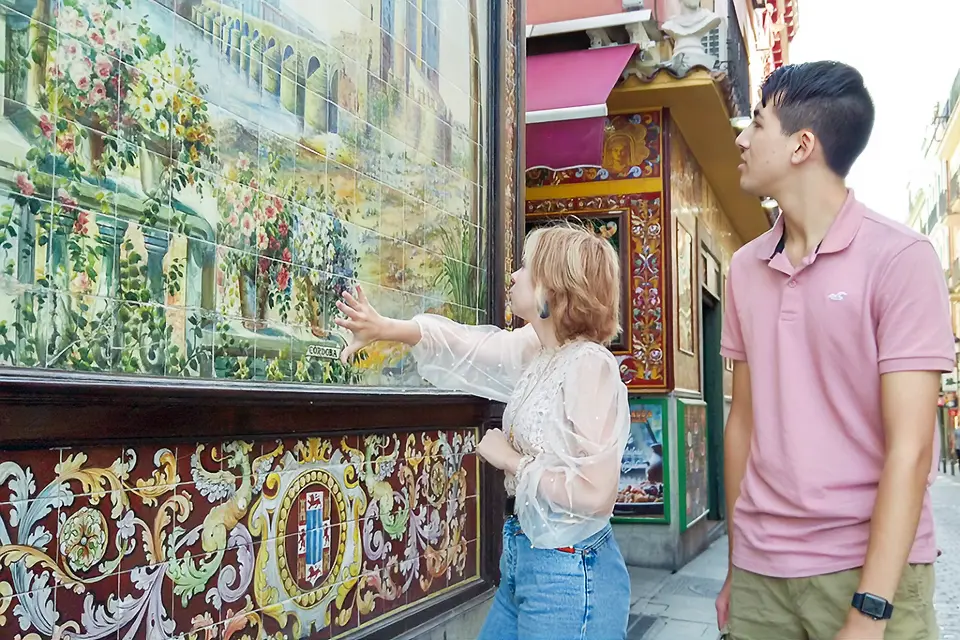
- Graduates will be able to articulate the importance of observing art in person.
Art history students must complete a minimum total of 37 credits for the major. Eighteen of the 37 credits must be from the 3000 and 4000 level courses.
| Code | Title | Credits |
|---|---|---|
| University Undergraduate Core | 32-35 | |
| Major Requirements | ||
| Introductory Courses | ||
| ARTH 1010 | Art and its Histories | 3 |
| Professional Preparation | ||
| ARTH 2000 | Art History Seminar | 1 |
| Research Course | ||
| ARTH 4900 | Research Methods | 3 |
| Global Arts | ||
| Select one course (3 credits) with the 'Art History - Global Arts' attribute. | 3 | |
| Studio Art Elective | ||
| ART 2000-level | Studio elective | 3 |
| Major Electives | ||
| Select 21 credits from the following two categories: | 21 | |
Select a minimum of 9 credits with the 'Art produced BEFORE 1800' attribute. | ||
Select a minimum of 9 credits with the Art produced AFTER 1800' attribute. | ||
| Internship or 3000/4000-level Elective | ||
| Select one of the following: | 3 | |
ARTH 4910 | Internship | |
ARTH 3000/4000 Elective | ||
| General Electives | 48-51 | |
| Total Credits | 120 | |
AP and Transfer Policies
No more than 18 credits of transfer credit may be applied to fulfill specific courses or elective courses towards the completion of the 37 credits required for the major in art history.
Advanced Placement credit, with a score of 4 or 5, will take the place of 3 credits for the Introductory courseARTH 1010 Art and its Histories (3 cr)
Continuation Standards
Students must have a minimum of a 2.00 average GPA in their major-related courses. Students who fall below a 2.00 average in major-related courses will be placed on probation. If the student fails to obtain at least a 2.00 average GPA in major-related courses after two consecutive semesters on probation the student will not be allowed to continue in the program.
This roadmap is just one example of a semester-by-semester plan of study for this program. There are other plans students can and do take. The plan of study for each particular student is established in consultation with each student’s academic advisor; this roadmap does not replace academic advising appointments.
Roadmap notes:
- This Roadmap assumes full-time enrollment unless otherwise noted.
- Courses/Milestones marked with an “!” are critical and must be completed in the semester listed in the Roadmap to ensure a timely graduation.
- Course availability and sequencing are subject to change.
| Year One | ||
|---|---|---|
| Fall | Credits | |
| ARTH 1010 | Art and its Histories (Recommended but not required that this course is taken in the first year) | 3 |
| CORE 1000 | Ignite First Year Seminar (Must be taken in first 36 credit hours at SLU / Cannot carry attributes) | 2-3 |
| CORE 1500 | Cura Personalis 1: Self in Community (Must be taken in first 36 credit hours at SLU / Cannot carry attributes) | 1 |
| CORE 1900 | Eloquentia Perfecta 1: Written and Visual Communication (Should be taken in first 36 credit hours at SLU / Cannot carry attributes) | 3 |
| General Electives | 6 | |
| Credits | 15-16 | |
| Spring | ||
| 2000-level Art History course for Global art requirement | 3 | |
| CORE 3200 | Ways of Thinking: Quantitative Reasoning (Should be taken in first 45 credit hours at SLU) | 3 |
| CORE 1600 | Ultimate Questions: Theology | 3 |
| General Electives | 6 | |
| Credits | 15 | |
| Year Two | ||
| Fall | ||
| ARTH 2000 | Art History Seminar (satisfies CORE 3500) | 1 |
| 2000-level ARTH course | 3 | |
| CORE 1200 | Eloquentia Perfecta 2: Oral and Visual Communication (Should be taken in first 60 credit hours at SLU / Cannot carry attributes) | 3 |
| CORE 1700 | Ultimate Questions: Philosophy | 3 |
| General Electives | 5 | |
| Credits | 15 | |
| Spring | ||
| 2000-level and 3000-level ARTH course | 6 | |
| CORE 3800 | Ways of Thinking: Natural and Applied Sciences | 3 |
| CORE 2500 | Cura Personalis 2: Self in Contemplation | 0 |
| General Electives | 6 | |
| Credits | 15 | |
| Year Three | ||
| Fall | ||
| Two 3000/4000-level ARTH courses | 6 | |
| CORE 2800 | Eloquentia Perfecta 3: Creative Expression | 2-3 |
| CORE 3400 | Ways of Thinking: Aesthetics, History, and Culture | 3 |
| General Electives | 4 | |
| Credits | 15-16 | |
| Spring | ||
| ARTH 4910 | Internship | 3 |
| 3000/4000-level Art History course | 3 | |
| CORE 3600 | Ways of Thinking: Social and Behavioral Sciences | 3 |
| CORE 4000 | Collaborative Inquiry | 2-3 |
| General Electives | 4 | |
| Credits | 15-16 | |
| Year Four | ||
| Fall | ||
| ARTH 4900 | Research Methods (may also be taken in first semester of third year) | 3 |
| CORE 3500 | Cura Personalis 3: Self in the World (May be added to a capstone for the major / Cannot carry attributes) | 1 |
| General Electives | 11 | |
| Credits | 15 | |
| Spring | ||
| 3000/4000-level ARTH course | 3 | |
| 2000-level ART course requirement | 3 | |
| General Electives | 9 | |
| Credits | 15 | |
| Total Credits | 120-123 | |
Note: SLU-Madrid and SLU-St. Louis program requirements vary slightly by campus.
Art history allows you to examine the significance of art across cultures and throughout history, keeping a critical eye on the contexts in which it was created. As a student of art history at SLU-Madrid, you will explore the cultural, historical and social contexts of art, which help us interpret the world around us. Through close examination of prominent periods and creators, you'll develop the skills ― critical analysis, research and communication ― necessary for success in careers in the arts and other professional fields.
Curriculum Overview
If you major or minor in art history at SLU-Madrid, you can complete all your courses in Spain or choose to study for one semester in St. Louis, Missouri. You can also design your own program. We transfer preapproved coursework completed at universities in other European art capitals ― Paris, London, or Rome, for example ― or anywhere in the world.
Art history majors whose research interests focus on European or Western art may complete coursework at other approved art history programs in Europe (an AAICU institution or another European university). Similarly, art history majors whose research interests focus on non-Western art may complete coursework at approved art history programs outside of Europe, including Kansai Gaidai University in Japan, Sogang University in South Korea and the Pontifícia Universidade Católica do Rio de Janeiro in Brazil.
Faculty
The faculty at Saint Louis University-Madrid are experts in their respective fields. They are internationally recognized teachers, researchers and mentors. Learn about our faculty members, including their education, credentials, experience and contact information.
Faculty Research
The SLU-Madrid faculty maintains robust programs of research in a variety of fields. See below for more data.
Find Faculty Research Information
Fieldwork, Internships and Careers
Our courses enrich your experience in Europe, allowing you to appreciate the art and architecture you see during your travels. We also organize visits to private collections that are inaccessible to the general public. The size of our program allows us close contact and mentorship with our students, as well as internship opportunities in museums both in Spain and the United States.
When you study art history at SLU-Madrid, you can apply for internships at cultural centers and artistic institutions in Madrid, including the offices of Sotheby's and Christie's auction houses. Students may also apply for an internship in the United States through our partnership with museums in St. Louis, Missouri. To apply, students must be registered for the art history major or minor and meet all SLU-Madrid internship requirements.
Admission
Application Deadlines
- April 1 - Fall admission (July 1 for EU students)
- Aug. 1 - Spring admission (Nov. 1 for EU students)
- March 1 - Summer sessions (for applicants who require a student visa)
- April 15 - Summer sessions (for applicants who do not require a student visa)
Contact Us
Office of Admissions
Avenida del Valle, 34
28003 Madrid, Spain
P: (+34) 91 554 58 58
admissions-madrid@slu.edu
Office Hours: Mondays through Fridays: 9 a.m. to 6 p.m. (3 p.m. on Fridays from May 15 - Sept. 1)
Tuition and Fees
SLU-Madrid is committed to providing a quality Jesuit education at an affordable price. Tuition rates at SLU-Madrid are approximately 40% lower than at comparable private universities in the U.S.
If you have questions or would like to speak with a financial aid officer, email us at financialaid-madrid@slu.edu.
2+SLU programs provide a guided pathway for students transferring from a partner institution.
For additional information about this program, please contact arts@slu.edu or call 314-977-2410.