Biology, B.A.
- Graduates will know core concepts of biology at all levels of biological organization. (Students will demonstrate their knowledge of the five core conceptual areas of biology identified by the Vision and Change report (AAAS, 2011): structure and function; information flow and storage; evolution; transformations of energy and matter; systems) at the cellular/molecular, organismal and ecosystem levels).
- Graduates will apply knowledge of biology and scientific ways of thinking to reason about complex questions. (Students will apply their understanding of biology and scientific reasoning skills to work on questions that require applying fundamental paradigms and ways of thinking across diverse biological systems. Application problems may require, for example, that students construct models, provide explanations, analyze texts or figures, recognize patterns, make inferences and predictions. Application problems should range from course- and content-specific questions to broader social, environmental and ethical questions).
- Graduates will use the tools of biology. (Students will acquire and practice biology laboratory and/or field techniques, manipulate and interpret data, and practice drawing conclusions from evidence).
Biology students must complete a minimum total of 48 credits for the major, 25 of which must be in BIOL subject code at the 3000 level or above.
| Code | Title | Credits |
|---|---|---|
| University Undergraduate Core | 32-35 | |
| Major Requirements | 48 | |
| BIOL 1240 & BIOL 1245 | General Biology: Information Flow and Evolution and Principles of Biology I Laboratory | 4 |
| BIOL 1260 & BIOL 1265 | General Biology: Transformations of Energy and Matter and Principles of Biology II Laboratory | 4 |
| BIOL 3010 | Evolutionary Biology | 3 |
| BIOL 3020 | Biochemistry and Molecular Biology | 3 |
| BIOL 3030 | Principles of Genetics | 3 |
| BIOL 3040 | Cell Structure & Function | 3 |
| BIOL 3070 | General Ecology | 3 |
| CHEM 1110 & CHEM 1115 | General Chemistry 1 and General Chemistry 1 Laboratory | 4 |
| CHEM 1120 & CHEM 1125 | General Chemistry 2 and General Chemistry 2 Laboratory | 4 |
| MATH 1510 | Calculus I | 4 |
| Statistics Course | ||
| STAT 1300 | Elementary Statistics with Computers | 3 |
| or BIOL 4790 | Biometry | |
| or BST 3100 | Applied Biostatistics I | |
| Biology Elective Courses | 10 | |
Choose a minimum of 10 credits of upper division elective courses (numbered BIOL 3060-BIOL 4980) | ||
One of these courses must be a structured laboratory course | ||
A total of 3 credits of BIOL 3970 Independent Research in Biology, BIOL 4970 Advanced Independent Research, BIOL 4980 Advanced Independent Study, and Internship courses (BIOL 3910-3919 and BIOL 4910-4919) can be counted toward the B.A. degree. These courses do not count as structured lab courses. | ||
| University Electives | 37-40 | |
| Total Credits | 120 | |
Independent Research
A total of 3 credits of BIOL 3970 Independent Research in Biology (1-3 cr), BIOL 4970 Advanced Independent Research (1-4 cr), and/or BIOL 4980 Advanced Independent Study (1-3 cr) can be counted toward the B.A. degree. These courses do not count as structured lab courses.
Continuation Standards
Students must have a 2.00 grade point average (GPA) in all courses used to fulfill major requirements. Students who fall below the 2.0 GPA in major coursework will be placed on program probation. If a student's major GPA falls below a 2.00 for two consecutive semesters, the student will be eligible for dismissal from the major.
This roadmap is just one example of a semester-by-semester plan of study for this program. There are other plans students can and do take. The plan of study for each particular student is established in consultation with each student’s academic advisor; this roadmap does not replace academic advising appointments.
Roadmap notes:
- This Roadmap assumes full-time enrollment unless otherwise noted.
- Courses/Milestones marked with an “!” are critical and must be completed in the semester listed in the Roadmap to ensure a timely graduation.
- Course availability and sequencing are subject to change.
| Year One | ||
|---|---|---|
| Fall | Credits | |
| BIOL 1240 & BIOL 1245 |
General Biology: Information Flow and Evolution and Principles of Biology I Laboratory (BIOL 1240 satisfies CORE 3800) |
4 |
| CHEM 1110 & CHEM 1115 |
General Chemistry 1 and General Chemistry 1 Laboratory |
4 |
| CORE 1000 | Ignite First Year Seminar (Must be taken in first 36 credit hours at SLU / Cannot carry attributes) | 2-3 |
| CORE 1500 | Cura Personalis 1: Self in Community (Must be taken in first 36 credit hours at SLU / Cannot carry attributes / Must be taken at SLU) | 1 |
| CORE 1900 | Eloquentia Perfecta 1: Written and Visual Communication (Should be taken in first 36 credit hours at SLU / Cannot carry attributes) | 3 |
| General Electives | 1 | |
| Credits | 15-16 | |
| Spring | ||
| Participation in First-year Mentoring Events | ||
| BIOL 1260 & BIOL 1265 |
General Biology: Transformations of Energy and Matter and Principles of Biology II Laboratory |
4 |
| CHEM 1120 & CHEM 1125 |
General Chemistry 2 and General Chemistry 2 Laboratory |
4 |
| CORE 1600 | Ultimate Questions: Theology | 3 |
| General Electives | 4 | |
| Credits | 15 | |
| Year Two | ||
| Fall | ||
| Participation in Second-year Mentoring | ||
| BIOL 3020 | Biochemistry and Molecular Biology | 3 |
| MATH 1510 | Calculus I (satisfies CORE 3200) | 4 |
| CORE 1700 | Ultimate Questions: Philosophy | 3 |
| CORE 1200 | Eloquentia Perfecta 2: Oral and Visual Communication | 3 |
| General Electives | 2 | |
| Credits | 15 | |
| Spring | ||
| BIOL 3040 | Cell Structure & Function | 3 |
| Statistics Elective | 3-4 | |
| CORE 2500 | Cura Personalis 2: Self in Contemplation | 0 |
| General Electives | 9 | |
| Credits | 15-16 | |
| Year Three | ||
| Fall | ||
| BIOL 3010 | Evolutionary Biology | 3 |
| Biology Elective | 3 | |
| CORE 3400 | Ways of Thinking: Aesthetics, History, and Culture | 3 |
| General Electives | 6 | |
| Credits | 15 | |
| Spring | ||
| BIOL 3030 | Principles of Genetics | 0-3 |
| Biology Elective | 3 | |
| CORE 3600 | Ways of Thinking: Social and Behavioral Sciences | 3 |
| CORE 4000 | Collaborative Inquiry | 2-3 |
| General Electives | 7 | |
| Credits | 15-19 | |
| Year Four | ||
| Fall | ||
| BIOL 3070 | General Ecology | 3 |
| Laboratory Elective | 1-5 | |
| CORE 3500 | Cura Personalis 3: Self in the World | 1 |
| General Electives | 10 | |
| Credits | 15-19 | |
| Spring | ||
| Biology Elective | 3 | |
| General Electives | 12 | |
| Credits | 15 | |
| Total Credits | 120-130 | |
- 1
See information in the program notes.
Program Notes
Statistics Electives
| Code | Title | Credits |
|---|---|---|
| STAT 1300 | Elementary Statistics with Computers | 3 |
| BIOL 4790 | Biometry | 4 |
| BST 3100 | Applied Biostatistics I | 3 |
Laboratory Electives
| Code | Title | Credits |
|---|---|---|
| BIOL 3060 | Cell Structure & Function Laboratory | 1 |
| BIOL 3100 | Experiments in Genetics Lab | 1 |
| BIOL 3260 | Biology of Plants & Fungi | 4 |
| BIOL 3420 | Comparative Anatomy of the Vertebrates | 5 |
| BIOL 3470 | General Physiology Laboratory | 1 |
| BIOL 3550X | Neuroscience Laboratory | 1 |
| BIOL 4050 | Molecular Techniques Lab | 2 |
| BIOL 4090 | Plant Ecology | 4 |
| BIOL 4100 | Natural History of Vertebrates | 4 |
| BIOL 4115 | Forest Park Living Lab Field Ecology Techniques | 1 |
| BIOL 4120 | Field Botany | 5 |
| BIOL 4130 | Field Mammalogy | 5 |
| BIOL 4140 | Field Ornithology | 5 |
| BIOL 4160 | Microbial Ecology and Molecular Evolution | 4 |
| BIOL 4200 | Aquatic Ecology | 4 |
| BIOL 4260 | Biology of Amphibians and Reptiles | 4 |
| BIOL 4280 | Biology of Fishes | 4 |
| BIOL 4320 | Cave Biology | 4 |
| BIOL 4330 | Spring Flora of the Ozarks | 4 |
| BIOL 4635 | Immunobiology Lab | 1 |
| BIOL 4370 | Animal Behavior Lab | 1 |
| BIOL 4420 | Antibiotic Resistance and Antibiotic Discovery | 2 |
| BIOL 4440 | Vertebrate Histology: Structure and Function of Tissues | 4 |
| BIOL 4610 | Developmental Biology Lab | 2 |
| BIOL 4650 | General Microbiology Laboratory | 2 |
| BIOL 4760 | General Ecology Laboratory | 1 |
2+SLU programs provide a guided pathway for students transferring from a partner institution.
Note: SLU-Madrid and SLU-St. Louis program requirements vary slightly by campus.
Biology is a fast-growing field of science. Important social issues such as developing cures for widespread diseases like cancer, fuel alternatives, managing natural resources, genetically modified food sources, or climate change can only be addressed by professionals who are well-educated in biology. Biology is a dynamic science aimed at understanding living organisms and how they interact with the environment.
Saint Louis University-Madrid's biology program offers courses that emphasize concepts over facts and aim to provide a foundation for careers in the life sciences, health professions, education and advanced post-graduate study in various disciplines. The B.A. in biology at SLU-Madrid provides maximum flexibility in selecting upper-division courses and is favored by students seeking double majors. It also provides a solid foundation in biological sciences, serving as a gateway to graduate studies and preparing students for advanced academic and professional opportunities.
Curriculum Overview
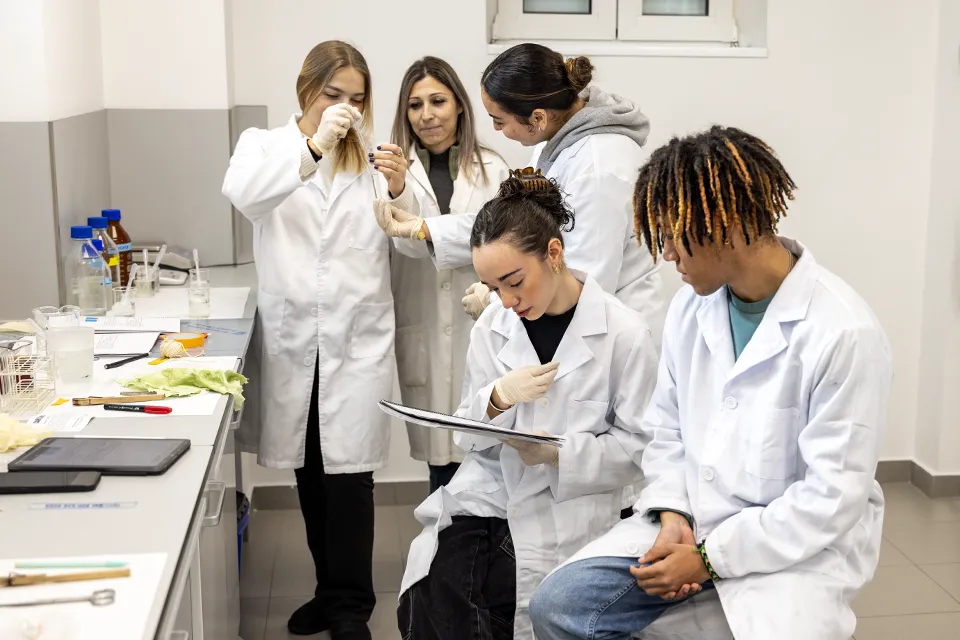
SLU-Madrid B.A. in biology program is supported by state-of-the-art laboratories that meet the highest teaching standards. These advanced facilities provide students with hands-on experience using cutting-edge technology and equipment, fostering a dynamic learning environment that bridges theory and practice.
SLU-Madrid's academic curriculum in biology is completely integrated with that of SLU-St. Louis. Therefore, students can complete the B.A. in biology at SLU-Madrid, and they may also transfer freely between the two sites throughout the undergraduate degree program.
Faculty
The faculty at Saint Louis University-Madrid are experts in their respective fields. They are internationally recognized teachers, researchers and mentors. Learn about our faculty members, including their education, credentials, experience and contact information.
Faculty Research
The SLU-Madrid faculty maintains robust programs of research in a variety of fields. See below for more data.
Find Faculty Research Information
Fieldwork, Internships and Careers
The Department of Biology at SLU-Madrid organizes visits to sites in Madrid and Spain where students integrate the biology courses in a hands-on way: Grefa (a wildlife recovery center and hospital for wild animals), Tablas de Daimiel National Park, Madrid Zoo, Royal Botanical Garden, among others.
SLU's biology major develops strong critical thinking and problem-solving skills that provide excellent preparation for professional schools, such as:
- Medical school
- Veterinary science school
- Dental school
- Optometry school
- Graduate school in a broad range of disciplines
Students not pursuing a degree in the medical and health professions at Saint Louis University must contact other institutions for admission information. Completing the premed prerequisite coursework does not guarantee entry into a medical school in the U.S. unless you have successfully completed the selection process of that medical school.
The skills biology majors gain also open the door to a wide variety of career options in health care, biotechnology, environmental management, conservation, education and the pharmaceutical industry.
Admission
Application Deadlines
- April 1 - Fall admission (July 1 for EU students)
- Aug. 1 - Spring admission (Nov. 1 for EU students)
- March 1 - Summer sessions (for applicants who require a student visa)
- April 15 - Summer sessions (for applicants who do not require a student visa)
Contact Us
Office of Admissions
Avenida del Valle, 34
28003 Madrid, Spain
P: (+34) 91 554 58 58
admissions-madrid@slu.edu
Office Hours: Mondays through Fridays: 9 a.m. to 6 p.m. (3 p.m. on Fridays from May 15 - Sept. 1)
Tuition and Fees
SLU-Madrid is committed to providing a quality Jesuit education at an affordable price. Tuition rates at SLU-Madrid are approximately 40% lower than at comparable private universities in the U.S.
If you have questions or would like to speak with a financial aid officer, email us at financialaid-madrid@slu.edu.
For additional information about this program, please contact biology@slu.edu or call 314-977-3900.