Nursing, B.S. (Accelerated)
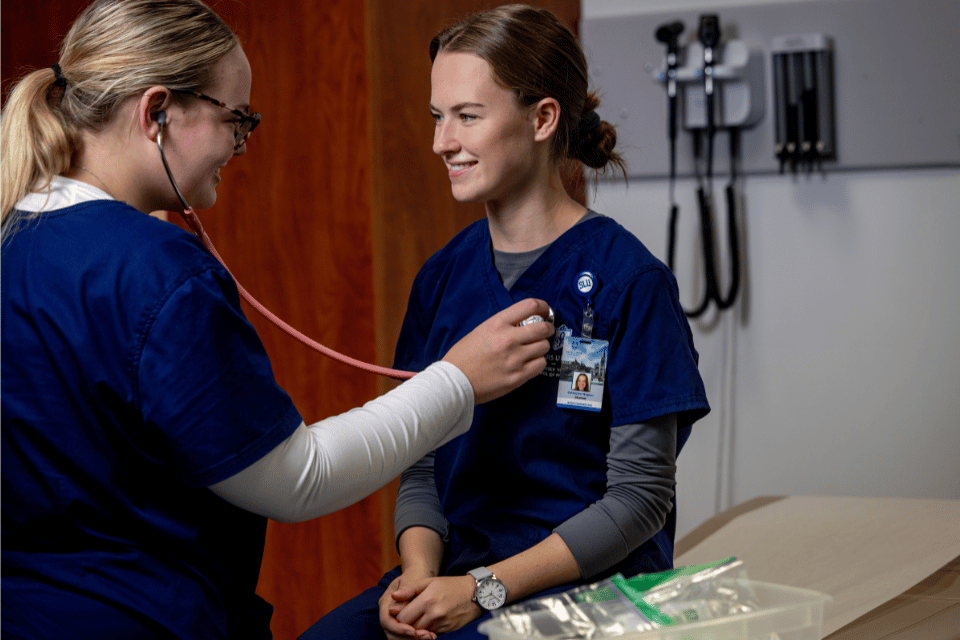
Saint Louis University’s accelerated B.S.N. option, or A.B.S.N., is an intensive three-semester, 12-month Bachelor of Science in Nursing program designed for students who already have a bachelor's degree in another area of study. However, undergraduate students who have at least 71 credits may be eligible to apply for the junior-entry accelerated option.
SLU created the accelerated B.S.N. program in 1971, which was the first and only program of its kind in the United States. The School of Nursing developed the program to meet the growing demands of students pursuing nursing after completing their undergraduate studies. The program offers students state-of-the-art classrooms and clinical labs, excellent clinical experiences in a wide variety of settings and a low student-to-faculty ratio for all clinical courses. The A.B.S.N. program can begin in fall or spring and includes a summer session. This program takes a hybrid approach with classes both online and in-person, hands-on and high-touch on the campus of Saint Louis University in St. Louis. Course requirements will include theory, practice lab and clinical work. Due to the accelerated pace of the A.B.S.N. program, it is strongly recommended that students do not work while attending school.
Apply to SLU's A.B.S.N. Program
Students who are reviewing our A.B.S.N. program may also consider our direct-entry 21-month accelerated M.S.N. program.
Curriculum Overview
Our accelerated bachelor of science in nursing program (A.B.S.N.) has the same outcomes as the traditional four-year option. It incorporates an integrated approach to learning, early synthesis and application of concepts and concentration on the nursing major.
Careers
Nursing graduates are eligible to take the NCLEX-RN, an exam that measures the competencies needed to perform as an effective entry-level nurse. The School of Nursing expects its graduates to be successfully hired after graduation or accepted into graduate programs.
Tuition
| Tuition | Total Program Cost |
|---|---|
| Nursing, B.S. (Accelerated) | $84,340 |
Additional charges may apply. Other resources are listed below:
Information on Tuition and Fees
Scholarships and Financial Aid
Financial aid may be available in the form of federal and private student loans. Federal loan eligibility is based on what was previously borrowed as an undergraduate student. For more information visit federal student loan limits. Federal loan consideration requires a completed Free Application for Federal Student Aid (FAFSA). View information on federal and private loans. View a preferred private student loan lender list.
Accreditation
The Saint Louis University Trudy Busch Valentine School of Nursing is fully approved by the Missouri State Board of Nursing.
The baccalaureate degree program in nursing, master's degree program in nursing, Doctor of Nursing Practice program and post-graduate advanced practice registered nurse (APRN) certificate program at Saint Louis University's Trudy Busch Valentine School of Nursing are accredited by the Commission on Collegiate Nursing Education, 665 K Street N.W., Suite 750, Washington, D.C., 20001. The commission's phone number is 202-887-6791.
Licensure Disclosure
For information about whether this program meets any state board of nursing's educational requirements for eligibility to take a state licensure exam, please see our Professional Licensure Disclosure page. Additionally, any change in your state of residence while enrolled in this program may impact your ability to remain enrolled in the program due to state and federal regulations.
1. Knowledge for Nursing Practice: Integrates an understanding of nursing’s distinct and shared disciplinary perspectives and applies theoretical and empirical knowledge from the humanities and natural, social, behavioral and nursing sciences to form the basis for clinical judgment and innovation in nursing practice.
2. Person-centered Care: Engages in nursing care through the relational lens, which fosters caring relationships, mutuality, active participation and individual empowerment in the delivery and communication of compassionate person-centered nursing care through cura personalis.
3. Population Health: Collaborates with diverse stakeholders for the advancement of effective partnerships, health policy and improvement of equitable population health outcomes related to the social determinants of health.
4. Scholarship for Nursing Discipline: Applies, translates and implements best evidence and client values into clinical decision-making.
5. Quality and Safety: Enhances quality of care while minimizing risk of harm to clients and providers through system effectiveness and individual performance.
6. Interprofessional Partnerships: Collaborates across professions with care team members, clients, families, communities and other stakeholders to optimize care, enhance the healthcare experience and strengthen outcomes.
7. Systems-based Practice: Effectively and proactively coordinates resources to provide safe, quality and equitable care to diverse populations within complex healthcare systems to address social and structural determinants of health.
8. Informatics and Healthcare Technologies: Utilizes information processes and technologies to manage and improve the delivery of safe, high-quality and efficient healthcare services.
9. Professionalism: Cultivates a sustainable professional nursing identity, accountability, perspective, collaborative disposition and ethical principles that reflect nursing’s characteristics and values.
10. Personal, Professional and Leadership Development: Participates in activities and self-reflection through Ignatian pedagogy that foster personal health, resilience and well-being while supporting the acquisition of nursing expertise, lifelong learning and the leadership continuum.
Admission Requirements
The Trudy Busch Valentine School of Nursing adheres to the principles of a holistic admission process in which selection criteria are broad-based and linked to our University’s and school’s mission and goals. While we do consider academic metrics, we also look at applicant experiences, attributes, potential for success, and how applicants may contribute to the school’s learning environment and to the profession.
Students with a Non-nursing Baccalaureate or Higher Degree
To be considered for admission, you must have completed a baccalaureate or higher degree from a regionally accredited U.S. college or university, or an international equivalent, with a grade point average of 3.00 on a 4.00 system in previous college work. If you do not meet the 3.00 GPA requirement, we have a holistic admissions process. This process will be detailed in an official emailed letter to you after your initial application is completed. The items we review for holistic admissions are community service, life experience, values, beliefs, integrity, maturity and leadership skills.
Prior to beginning the program, you must complete the following course prerequisites with a grade of "C" or higher from a regionally accredited university, college or community college. Contact slunurse@slu.edu for an unofficial transcript review.
A.B.S.N. Prerequisites
- Chemistry (3 credits)
- Human Anatomy* (3 credits)
- Human Physiology* (3 credits)
- Microbiology (3 credits)
- Inferential and Descriptive Statistics (3 credits)
- Theology or Religion (3 credits)
- Philosophy or Ethics (3 credits)
- Human Growth and Development/Developmental Psychology (3 credits)
- Social Behavioral Science (3 credits)
- English Composition II (3 credits)
- Oral Communication (3 credits)
- Fine Arts (3 credits)
- Any History, Literature, Politics, Geography, Philosophy, Religion, or Art (3 credits)
*Human Anatomy and Human Physiology can be substituted for Anatomy & Physiology I and Anatomy & Physiology II; however, you must take either-or, not a combination.
Requirements for Undergraduate Non-degreed Students (Junior Entry)
You must have a minimum cumulative grade point average of 3.00 on a 4.00 system in previous college work and at least 71 transferable credits from a regionally accredited university, college or community college. The 71 credits must include all courses necessary to meet School of Nursing requirements. A minimum of 120 credits is required to graduate from the A.B.S.N. program.
Prior to beginning the program, you must complete the following course prerequisites with a grade of "C" or higher from a regionally accredited university, college or community college. For more information regarding the junior-entry A.B.S.N. option, email slunurse@slu.edu.
Junior Entry ABSN Prerequisites
- Written Composition II* (3 credits)
- Inferential and Descriptive Statistics* (3 credits)
- Oral Communication* (3 credits)
- Microbiology (3 credits)
- Philosophy* (3 credits)
- Human Anatomy** (3 credits)
- Human Physiology** (3 credits)
- Human Growth and Development Across the Lifespan (3 credits)
- Theology* (3 credits)
- Chemistry with Lab (4 credits)
- General Psychology* (3 credits)
- Aesthetics, History and Culture* (3 credits)
- Fine Arts (Creative Expression)* (2-3 credits)
* Courses that must fulfill the Undergraduate University Core.
**Human Anatomy and Human Physiology can be substituted for Anatomy & Physiology I and Anatomy & Physiology II; however, you must take either-or, not a combination.
Application Process
Applying for the accelerated B.S.N. option requires careful planning to ensure that all admission requirements are met. You may experience a significant delay in processing if the application instructions are not followed exactly as listed. Although there is no official application deadline, we encourage you to complete the application process as soon as possible, as space is limited.
We cannot accept students who have been dismissed from previous nursing programs or have non-successful completion in courses such as pharmacology and/or pathophysiology, regardless of the program.
Please follow the steps below to apply:
- Step 1: Application
Submit an application for admission. - Step 2: Transcripts
Submit your official transcripts from all colleges/universities directly to Saint Louis University. If you have completed college coursework outside the U.S., you must submit a course-by-course academic evaluation from WES, NACES-member or AICE-member. - Step 3: Resume
Attach your professional resume within your application portal. - Step 4: Professional Goal Statement
Attach your professional goal statement within your application portal. The goal statement should outline your anticipated nursing career trajectory for five years after graduating and include an explanation of why you've decided on that path. The statement should be one-to-two pages and double-spaced. - Step 5: Admission Interview
A personal interview may be required.
Review Process
The application review process is ongoing, and applications are reviewed weekly, until the program is full. Decisions for junior-entry students begin in early January after the application has been completed, transcripts have been verified and the associated CAS fee has been paid.
Your official transcripts will be reviewed when every item above has been received. Notification of your eligibility for consideration for admission to the accelerated B.S.N. program will be sent to you from the dean of admissions. This correspondence will include a list of any required course prerequisites that you must complete prior to full admission to the accelerated option.
For more information, contact slunurse@slu.edu.
Program Requirements
It is anticipated that, for all ABSN students (particularly those entering the ABSN having already completed a bachelor's degree), some University Core and most Elective requirements will be satisfied via transfer credit. The 120 total credits represented below is a University- and accreditor-established minimum; depending on an individual student's transfer credit, that total could be higher.
| Code | Title | Credits |
|---|---|---|
| Undergraduate University Core | 32-35 | |
| Major Requirements | 49 | |
| NURS 2495 | Developing Professional Nursing Identity and Communication Competence | 2 |
| NURS 2515 | Health Promotion Across the Lifespan | 2 |
| NURS 2595 | Foundations of Nursing Care | 4 |
| NURS 3200 | Health Assessment | 3 |
| NURS 3330 | Pharmacotherapeutics for Nursing Care | 3 |
| NURS 3360 | Pathophysiology | 3 |
| NURS 3430 | Psychiatric/Mental Health Nursing | 3 |
| NURS 3445 | Public Health Nursing | 4 |
| NURS 3485 | Maternal/Neonatal Nursing | 3 |
| NURS 3490 | Child Health Nursing | 3 |
| NURS 3705 | Interprofessional Issues in Evidence Based Care | 2 |
| NURS 3460 | Nursing Care of the Adult | 4 |
| NURS 3470 | Nursing Care of the Older Adult | 4 |
| NURS 4300 | Complex Care Theory | 2 |
| NURS 4355 | Complex Care Practicum | 4 |
| NURS 4485 | Leadership and Synthesis in Professional Nursing Practice | 3 |
| University Electives | 39 | |
| Total Credits | 120 | |
Continuation Standards
The School of Nursing requires a minimum cumulative GPA of 2.50.
Per section 335.066 RSMo of the Missouri Nursing Practice Act, completion of the nursing program does not guarantee eligibility to take the licensure examination.
This roadmap is just one example of a semester-by-semester plan of study for this program. There are other plans students can and do take. The plan of study for each particular student is established in consultation with each student’s academic advisor; this roadmap does not replace academic advising appointments.
Roadmap notes:
- This Roadmap assumes full-time enrollment unless otherwise noted.
- Courses/Milestones marked with an “!” are critical and must be completed in the semester listed in the Roadmap to ensure a timely graduation.
- Course availability and sequencing are subject to change.
The below roadmaps only list required nursing coursework. Students may still be required to take additional University Undergraduate Core or elective credit to meet the minimum 120 credits.
Fall Start
| Year One | ||
|---|---|---|
| Fall | Credits | |
| NURS 2495 | Developing Professional Nursing Identity and Communication Competence | 2 |
| NURS 2515 | Health Promotion Across the Lifespan | 2 |
| NURS 2595 | Foundations of Nursing Care | 4 |
| NURS 3200 | Health Assessment | 3 |
| NURS 3330 | Pharmacotherapeutics for Nursing Care | 3 |
| NURS 3360 | Pathophysiology | 3 |
| Credits | 17 | |
| Spring | ||
| NURS 3460 | Nursing Care of the Adult | 4 |
| NURS 3470 | Nursing Care of the Older Adult | 4 |
| NURS 3490 | Child Health Nursing | 3 |
| NURS 3485 | Maternal/Neonatal Nursing | 3 |
| NURS 3705 | Interprofessional Issues in Evidence Based Care | 2 |
| Credits | 16 | |
| Summer | ||
| NURS 3430 | Psychiatric/Mental Health Nursing | 3 |
| NURS 3445 | Public Health Nursing | 4 |
| NURS 4300 | Complex Care Theory | 2 |
| NURS 4355 | Complex Care Practicum | 4 |
| NURS 4485 | Leadership and Synthesis in Professional Nursing Practice | 3 |
| Credits | 16 | |
| Total Credits | 49 | |
Spring Start
| Year One | ||
|---|---|---|
| Spring | Credits | |
| NURS 2495 | Developing Professional Nursing Identity and Communication Competence | 2 |
| NURS 2515 | Health Promotion Across the Lifespan | 2 |
| NURS 2595 | Foundations of Nursing Care | 4 |
| NURS 3200 | Health Assessment | 3 |
| NURS 3330 | Pharmacotherapeutics for Nursing Care | 3 |
| NURS 3360 | Pathophysiology | 3 |
| Credits | 17 | |
| Summer | ||
| NURS 3430 | Psychiatric/Mental Health Nursing | 3 |
| NURS 3460 | Nursing Care of the Adult | 4 |
| NURS 3485 | Maternal/Neonatal Nursing | 3 |
| NURS 3490 | Child Health Nursing | 3 |
| NURS 3705 | Interprofessional Issues in Evidence Based Care | 2 |
| Credits | 15 | |
| Fall | ||
| NURS 3445 | Public Health Nursing | 4 |
| NURS 3470 | Nursing Care of the Older Adult | 4 |
| NURS 4300 | Complex Care Theory | 2 |
| NURS 4355 | Complex Care Practicum | 4 |
| NURS 4485 | Leadership and Synthesis in Professional Nursing Practice | 3 |
| Credits | 17 | |
| Total Credits | 49 | |
Program Notes
The A.B.S.N. program begins in the spring and fall terms. Courses are offered twice per year.
For additional admission questions, please contact the School of Nursing's recruitment and enrollment staff:
314-977-8995
slunurse@slu.edu