M.S.H.A. Gives Farzana Hoque, M.D. Skills to Make a Bigger Impact With Patients, Students
Farzana Hoque, M.D., M.S.H.A., MRCP, FACP, FRCP has evolved at Saint Louis University as a physician leader and educator, grounded in the mission of cura personalis while serving her patients, students and the community.
Hoque’s (M.S.H.A. ‘25) career path has taken her through various leadership and administrative roles throughout education and hospital systems.
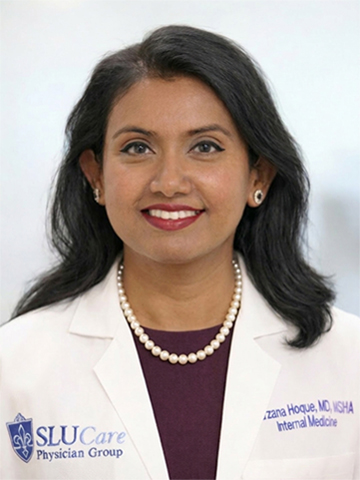
Most recently, Hoque became one of the first graduates of the SLU Master of Science in Health Administration (M.S.H.A.) degree program, a program designed for future and current healthcare professionals seeking to accelerate their careers.
“As a frontline physician, patient care always comes first. This program (M.S.H.A.) reassured me that — even with a busy schedule — I was building the critical skill set to make a bigger impact for a larger number of patients, which felt both meaningful and refreshing,” she said.
She is an associate professor of medicine, acting internship co-director at Saint Louis University School of Medicine and the inaugural medical director of Bordley Tower at SSM Health Saint Louis University Hospital. She is also a board member for The Academy of Science of St. Louis and the YWCA Metro St. Louis.
“I have evolved at SLU as a physician leader and educator, grounded in the mission of cura personalis. That shared mission, along with my long-standing trust in the SLU community and world-class academic standards, drew me to pursue MSHA at SLU,” she said. "Being a Billiken is both a privilege and a responsibility, and I am committed to advancing our shared mission to our patients, students and community."
After becoming board-certified in internal medicine and entering into her first attending physician role, Hoque realized that delivering exceptional care was only a fraction of the health care equation she was working to solve.
She decided then to expand her impact beyond one patient at a time by pursuing mission-driven leadership.
“My goals are to deliver exceptional care to our patients and communities while advancing sustainable, positive outcomes that position our hospital to thrive,” she said.
Early in her career, she sat at the table with C-suite leaders and repeatedly heard strategic and financial concepts that were lessons not previously available to her. She recognized that to be an effective leader later in her career she’d need to learn the core concepts and language to effectively communicate with healthcare leaders to advocate for system design and improvement and close the gaps patients and frontline staff face at the bedside.
“That is why I chose to pursue the M.S.H.A.,” Hoque said. “(The M.S.H.A.) amplified my strategic operational acumen and skillset from simply identifying gaps to designing and implementing evidence-based, multidisciplinary, actionable strategies that amplify quality of care, patient safety, and patient experience at SLU and beyond.”
Hoque credits the SLU M.S.H.A program for providing a “world-class curriculum, brilliant faculty, and a unique balance of flexibility and environment that challenged her ways conducive to growth.”
As she studied healthcare management, organizational strategy, and operational finance throughout her education and career, she consistently asked herself how each concept could apply to clinical and leadership roles.
As a medical director she would reflect on how an operational model could influence key performance indicators (KPIs) such as patient experience metrics, length of stay. This fostered a habit of translating theory into real-life system application, and strengthened both her academic performance and analytical skill.
The M.S.H.A. program, built for future and current health care professionals, translated directly into Hoque’s current role as a medical director.
Now, Hoque uses her knowledge and skill gained through the SLU M.S.H.A. in her day-to-day roles.
“The coursework and case-based exams created a platform to apply learned operational and leadership tools in real time as I lead our key initiatives to elevated patient-experience,” she said. “The program sharpened my comprehensive understanding of the US healthcare system and empowered me to take data-driven, actionable steps to solve the challenges my teams face every day.”
Using her knowledge of healthcare policies has made her better prepared to advocate for patients to insurance companies.
She is now able to implement strategic and operational insight, quality improvement concepts, and data-driven tools into daily operations to improve key metrics such as elevating patient experience, and ensuring exceptional, patient-centered care.
As an educator and mentor for medical students and resident physicians, she also brings these evidence-based healthcare concepts into bedside teaching and classes to spread this knowledge among the next generation of physicians.
“To busy professionals who are eager to learn and lead, I highly recommend SLU M.S.H.A., because knowledge is power,” she said. “A driven leader is someone who continuously learns and continuously improves. This program reinforced my awareness to recognize my areas of expertise and areas that need to be further honed to expand my impact in this complex healthcare landscape.”
Hoque also credits the lasting impact of relationships formed while in the program with faculty and mentors in the program.
“Most importantly, I built lifelong relationships with incredible peers and mentors whose wisdom will stay by my side as true gifts,” she said. “(I am) blessed to have valuable guidance and mentorship from Professors Mark Gaynor, Kimberly Enard and Marcia Walter throughout this program.”
College for Public Health and Social Justice
The Saint Louis University College for Public Health and Social Justice is the only academic unit of its kind, studying social, environmental and physical influences that together determine the health and well-being of people and communities. It also is the only accredited school or college of public health among nearly 250 Catholic institutions of higher education in the United States. Guided by a mission of social justice and focus on finding innovative and collaborative solutions for complex health problems, the college offers nationally recognized programs in public health and health administration.